
Featured Methods

Second-dimension spatial association
Authors: Yongze Song, Curtin University, Australia
Background: Geospatial data contains essential information on geographical characteristics, but current spatial prediction models are limited in extracting diverse geographical information outside sample locations.
Advantages: The second-dimension spatial association (SDA) examines spatial association by extracting more information about the geographical environment outside sampling locations.

Geographically weighted artificial neural network
Authors: Julian Hagenauer, Heidelberg University, Germany
Background: The Geographically Weighted Artificial Neural Network (GWANN) combines geographic weighting and neural network technologies, overcoming the limitations of traditional Geographically Weighted Regression (GWR) that can only handle linear relationships.
Advantages: GWANN can model nonlinear functions without any assumptions, enhancing its predictive performance and applicability in handling complex spatial data.
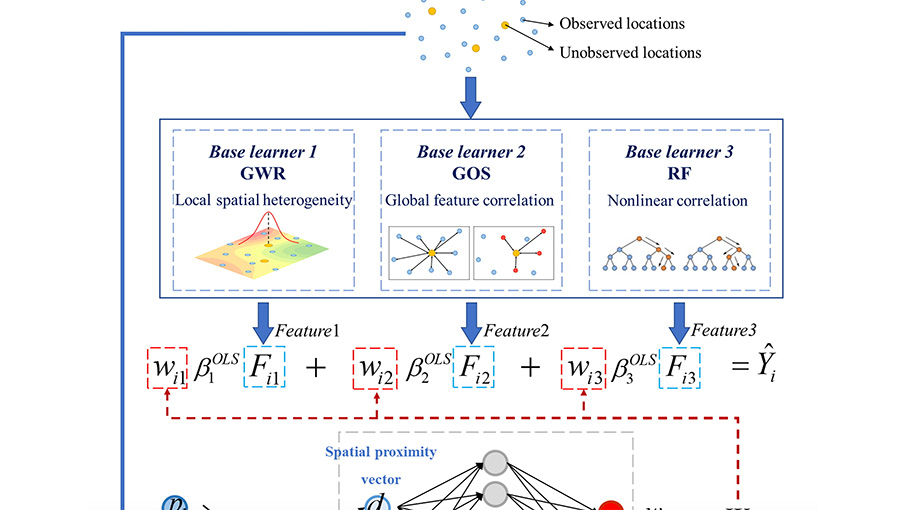
Spatial heterogeneous ensemble learning
Authors: Shifen Cheng, University of Chinese Academy of Sciences, China
Background: Geographical Spatial Heterogeneous Ensemble Learning (GSH-EL) combines three models—Geographically Weighted Regression, Geographically Optimal Similarity, and Random Forest—to effectively capture local spatial differences, global feature connections, and nonlinear relationships in geographical data.
Advantages: GSH-EL uses the Spatially Weighted Ensemble Neural Network Module (SWENN) to capture complex nonlinear relationships between spatial proximity and ensemble weights for more accurate predictions.

Multilayer network community detection and kernel extension
Authors: Liyan Xu, Peking University, Beijing, China
Background: Existing geographical regionalization methods typically focus on either spatial attributes or spatial interactions, while real-world tasks often require considering both simultaneously to meet multiple objectives, leading to the proposal of a new method to address this issue.
Advantages: MNCD-KE simultaneously considers spatial attributes and spatial interactions while satisfying geographical constraints such as spatial contiguity, region size balance, and morphological regularity.
We invite you to
share your featured research
on spatial theories and methods to broader fields and researchers.

 Spatial Methods